¥234.00 CNY
Single Bottle (30 Servings)
SKU: CN13158US
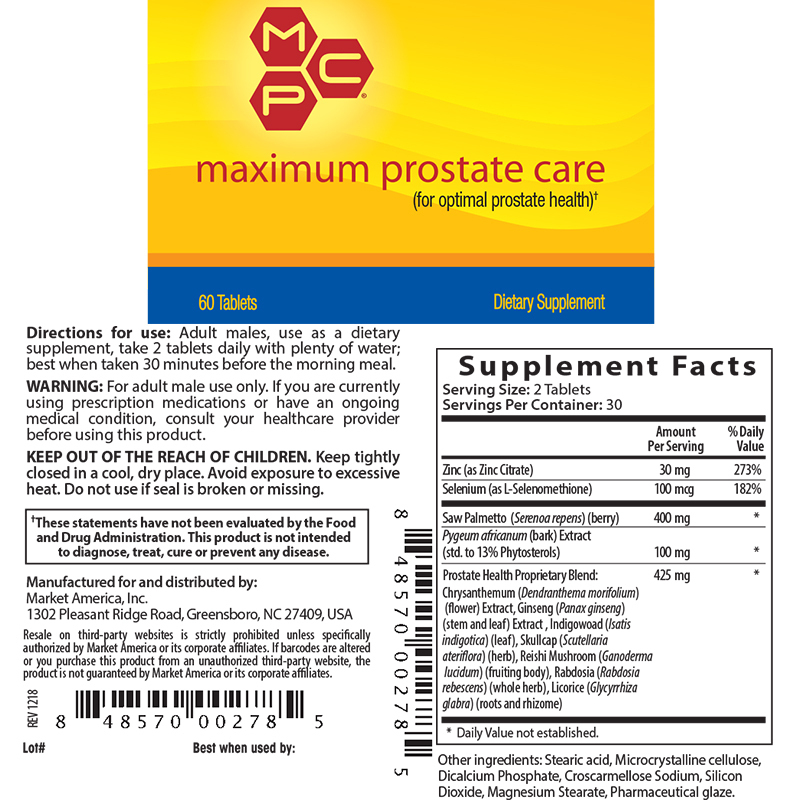
Every man should be aware of the need for taking the right steps to maintaining prostate health. Prime MPC provides prostate support by helping to promote a healthy prostate function.The prostate plays a critical role in men's health. Maintaining prostate health is essential for a man's overall health and enhances quality of life.The use of herbs to promote male wellbeing is increasingly popular. Prime MPC combines five potent herbs and two select nutrients that work synergistically to promote health. Each of these ingredients has been carefully selected to benefit men’s health.This unique formulation of Prime MPC provides total prostate support and work to promote prostate health and provide antioxidant protection.
See detailsBenefits
- Supports prostate health
- Supports healthy prostate functions
Gluten Free - the finished product contains no detectable gluten.*
Vegetarian - this product is vegetarian.
* USA FDA classifies gluten-free as a finished product containing less than 20PPM gluten.
Details
Every man should be aware of the need for taking the right steps to maintaining prostate health. Prime MPC provides prostate support by helping to promote a healthy prostate function.
The prostate plays a critical role in men's health. Maintaining prostate health is essential for a man's overall health and enhances quality of life.
The use of herbs to promote male wellbeing is increasingly popular. Prime MPC combines five potent herbs and two select nutrients that work synergistically to promote health. Each of these ingredients has been carefully selected to benefit men’s health.
This unique formulation of Prime MPC provides total prostate support and work to promote prostate health and provide antioxidant protection.
Ingredients
Plant Sterols
Research has shown that supplementing with plant sterols, especially beta sitosterol, helps to maintain a healthy prostate. Animal research suggests that plant sterols might also promote normal 5-alpha-reductase activity.
Stinging Nettle Root Extract
Stinging nettle or common nettle, Urtica dioica, is an herbaceous perennial flowering plant, native to Europe, Asia, northern Africa and North America. Stinging nettle research suggests that it helps maintain normal levels of 5-alpha-reductase.
Pumpkin Seed Extract
Pumpkin seed extract is rich in protein, carotenoids, vitamin E, and fatty acids. Pumpkin seed extract aids in prostate health by helping to maintain bladder comfort.
geniVida™† (Genistein)
geniVida is a high-purity, non-plant derived, non-allergenic form of genistein. Genistein is a flavonoid that has been shown to support prostate functions in men. Genistein appears to inhibit 5 alpha-reductase.
†geniVida™ is a trademark of DSM Nutritional Products.
Grape Seed Extract
Grape seed extract contains polyphenols, compounds with antioxidant activity. Research has shown that grape seed extract can support healthy prostate functions.
Zinc
Zinc is an important trace mineral found in every cell of the body. The best dietary sources of zinc are from seafood, meats, fish, poultry and eggs.
Zinc helps to maintain prostate health. Within the body, zinc accumulates higher in prostate than in any other soft tissue and those with prostate concerns often test low for zinc.
FAQ
Is Prime MPC (Maximum Prostate Care) for men only?
Yes. While the ingredients in this product could be beneficial to everyone, it is especially designed for a man’s body, particularly with maintaining a healthy prostate. Each ingredient in Prime MPC is helpful to a variety of health issues that may affect men and women, however, Prime MPC was created for each of these ingredients to work synergistically to promote healthy prostate.
Is Prime MPC (Maximum Prostate Care) only for older men?
No, this product is designed for men of all ages. While poor prostate health is rare in younger men, men of all ages should be concerned with proper prostate care. The ingredients would be beneficial for all men. Men should take care of their prostate when they are younger to help maintain prostate health in the future.
Is taking Prime MPC (Maximum Prostate Care) all I need to do to maintain a healthy prostate?
No. Dietary supplements alone are not the only way to support healthy prostate functions. A sensible diet, regular exercise, as well as avoiding cigarette smoking and excessive alcohol consumption, are elements of a healthy lifestyle that can contribute to healthy prostate maintenance.
I was just diagnosed with prostate cancer. Can I take Prime MPC (Maximum Prostate Care)?
Prime MPC is made of all natural herbs and select nutrients, designed specifically to support a healthy prostate. Because of the myriad of treatments associated with prostate cancer, you should consult your doctor before taking Prime MPC. You should be sure to consult with your doctor that none of the ingredients will interfere with any medications.
Is Prime MPC (Maximum Prostate Care) safe?
This product is safe and free of harmful chemicals, preservatives and alcohol. This product is made in the United States in FDA-inspected facilities using Good Manufacturing Practices. Customers can have confidence in the quality and safety of this product.
Science
- Adams, L, et al. Analysis of the interactions of botanical extract combinations against the viability of prostate cancer cell lines. Evidence-based Complementary and Alternative Medicine. 3(1): 117-124, 2006.
- Al-Shukri, S., et al. Early urodynamic effects of the lipido-sterolic extract of Serenoa repens (Permixon(R)) in patients with lower urinary tract symptoms due to benign prostatic hyperplasia. Prostate Cancer and Prostatic Diseases. 3(3): 195-199, 2000.
- Bonham, M., et al. Characterization of chemical constituents in Scutellaria baicalensis with antiandrogenic and growth-inhibitory activities toward prostate carcinoma. Clinical Cancer Research. 11(10): 3905-3914, 2005.
- Chan, F., et al. Induction of apoptosis in prostate cancer cell lines by a flavonoid, baicalin. Cancer Letters. 160(2): 219-228, 2000.
- Chan, P., et al. Protective effects of trilinolein extracted from Panax notoginseng against cardiovascular disease. Acta Pharmacologica Sinica. 23(12): 1157-1162, 2002.
- Chatelain, C., et al. Comparison of once and twice daily dosage forms of Pygeum africanum extract in patients with benign prostatic hyperplasia: a randomized, double-blind study, with long-term open label extension. Urology. 54(3): 473-478, 1999. Chatelain, C., et al. Comparison of once and twice daily dosage forms of Pygeum africanum extract in patients with benign prostatic hyperplasia: a randomized, double-blind study, with long-term open label extension. Urology. 54(3): 473-478, 1999.
- Chen, S. In vitro mechanism of PC SPES. Urology. 58(2 Suppl 1): 28-35, 2001.
- Chen, S., et al. Total saponins of Panax notoginseng protected rabbit iliac artery against balloon endothelial denudation injury. Acta Pharmacologica Sinica. 25(9): 1151-1156, 2004.
- Choi, Y., et al. In vitro and in vivo experimental effect of Korean red ginseng on erection. Journal of Urology. 162(4): 1508-1511, 1999.
- Costello, L. and Franklin, R. Novel role of zinc in the regulation of prostate citrate metabolism and its implications in prostate cancer. Prostate. 35(4): 285-296, 1998.
- Dardenne, M. Zinc and the immune system. European Journal of Clinical Nutrition. 56 (Suppl 3): S20-S23, 2002.
- Fair, W., et al. Cancer of the prostate: a nutritional disease? Urology. 50(6): 840-848, 1997.
- Friedl, R., et al. Stimulation of nitric oxide synthesis by the aqueous extract of Panax ginseng root in RAW 264.7 cells. British Journal of Pharmacology. 134(8): 1663-1670, 2001.
- Geliebter, J., et al. PC-SPES and prostate cancer. Journal of Nutrition. 131(1): 164S-166S, 2001.
- Gordon, A. and Shaughnessy, A. Saw palmetto for prostate disorders. American Family Physician. 67(6): 1281-1283, 2003.
- Ho, E., et al. Dietary zinc supplementation inhibits NFkappaB activation and protects against chemically induced diabetes in CD1 mice. 226(2): 103-111, 2001.
- Kubota, T., et al. PC-SPES: a unique inhibitor of proliferation of prostate cancer cells in vitro and in vivo. Prostate. 42(3): 163-171, 2000.
- Lukaski, H. Low dietary zinc decreases erythrocyte carbonic anhydrase activities and impairs cardiorespiratory function in men during exercise. American Journal of Clinical Nutrition. 81(5): 1045-1051, 2005.
- MacKay, D. Nutrients and botanicals for erectile dysfunction: examining the evidence. Alternative Medicine Review. 9(1): 4-16, 2004.
- Mathe, G., et al. A Pygeum africanum extract with so-called phyto-estrogenic action markedly reduces the volume of true and large prostatic hypertrophy. Biomedicine and Pharmacotherapy. 49(7-8): 341-343, 1995.
- Mocchegiani, E., et al. Zinc, oxidative stress, genetic background and immunosenescence: implications for healthy ageing. Immunity and Ageing. 3:6, 2006.
- Platz, E. and Helzisouer, K. Selenium, zinc, and prostate cancer. Epidemiologic Reviews. 23(1): 93-101, 2001.
- Murphy, L. and Lee, J. Ginseng, sex behavior, and nitric oxide. Annals of the New York Academy of Sciences. 962: 372-377, 2002.
- Pirani, J. The effects of phytotherapeutic agents on prostate cancer: an overview of recent clinical trials of PC SPES. Urology. 58(2): 36-38, 2001.
- Platz, E. and Helzisouer, K. Selenium, zinc, and prostate cancer. Epidemiologic Reviews. 23(1): 93-101, 2001.
- Prasad, A., et al. Zinc status and serum testosterone levels of healthy adults. Nutrition. 12(5): 344-348, 1996.
- Ravaglia, G., et al. Effect of micronutrient status on natural killer cell immune function in healthy free-living subjects aged /=90 y. American Journal of Clinical Nutrition. 71(2): 590-598, 2000.
- Rowland, D. and Tai, W. A review of plant-derived and herbal approaches to the treatment of sexual dysfunctions. Journal of Sex and Marital Therapy. 29(3): 185-205, 2003.
- Santillo, V. and Lowe, F. Role of vitamins, minerals and supplements in the prevention and management of prostate cancer. International Journal of the Brazilian Society of Urology. 32(1): 3-14, 2006.
- Taille, A., et al. Herbal therapy PC-SPES: in vitro effects and evaluation of its efficacy in 69 patients with prostate cancer. Journal of Urology. 164(4): 1229-1234, 2000.
- van der Brandt, P., et al. A prospective cohort study on selenium status and the risk of lung cancer. Cancer Research. 53(20): 4860-4865, 1993.
- Wilt, T., et al. Saw palmetto extracts for treatment of benign prostatic hyperplasia: a systematic review. Journal of the American Journal Association. 280(18): 1604-1609, 1998.
- Yanai, K., et al. Utilization study of stems and leaves of Tienchi Ginseng. I. Anti-hypertensive effect of stems and leaves of Tienchi Ginseng on stroke-prone spontaneously hypertensive rat (SHRSP). Bioscience, Biotechnology, and Biochemistry. 70(10): 2501-2507, 2006.
- Zhou, W., et al. Molecular mechanisms and clinical applications of ginseng root for cardiovascular disease. Medical Science Monitor. 10(8): RA187-RA192, 2004.
- Zu, K. and Ip, C. Synergy between selenium and vitamin E in apoptosis induction is associated with activation of distinctive initiator caspases in human prostate cancer cells. Cancer Research. 63(20): 6988-6995, 2003.