¥324.00 CNY
单瓶装(30份)
产品代号(SKU): CN13285US
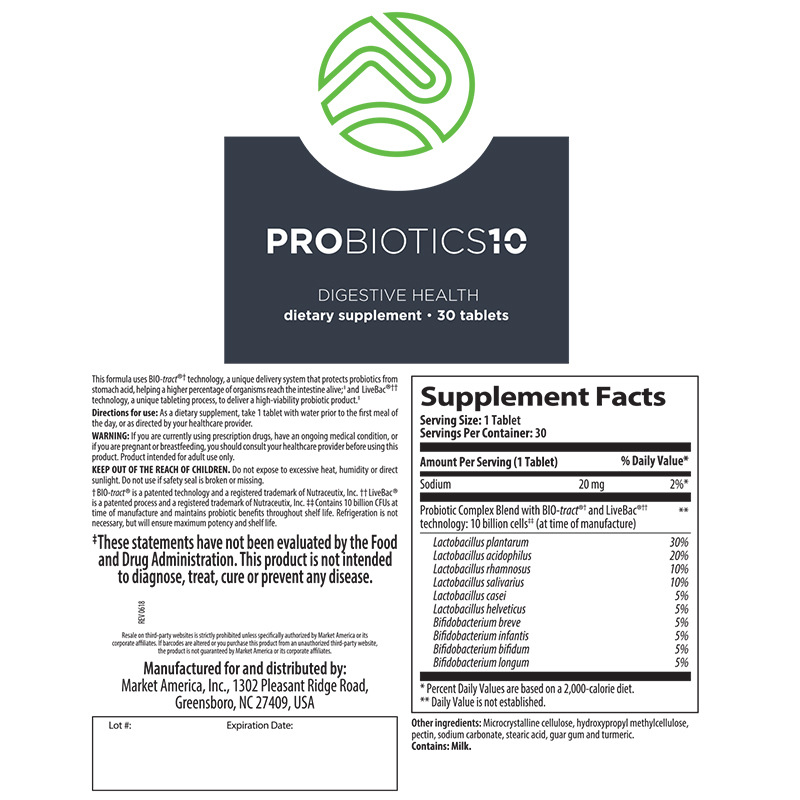
细菌往往让人想到其负面含义 — 然而,并非所有的细菌都有害。消化道内存在着数百种不同的细菌,被称为微生物丛。这些细菌中的一些能够促进人体健康的消化功能。维持好细菌与“坏”细菌的健康平衡状态不仅可以促进消化健康,还可以增进免疫系统健康。究其根本,约70-80%的免疫系统都在消化道也就是肠道里!益生菌方案经过大量深入研究,用于维持这种平衡,并有助于维持肠道生态系统内细菌的健康定植。益生菌能够提供有益细菌来中和有害细菌,从而增进消化系统健康。1*外部环境中的毒素、以及来自压力、过量饮酒和不良饮食等不健康的生活因素使维持肠道生态平衡越来越重要。Probiotics-10益生菌配方-10助您保持肠道健康!我们的配方提供10种最常见并经充分研究的益生菌菌株,每种菌株都具有不同的益处,它们协效运作,有益于多方面身体健康,包括提高免疫力、增进胃部舒适感及促进肠道规律运动等。*虽然其他益生菌产品也提供大量的菌落形成单位(CFU)和益生菌菌株,但益生菌配方-10可提供更全面的支援。其他竞争对手的产品可能由于其制造工艺和保质期短而容易导致活益生菌数量降低。待到食用这些产品时,其效用已经明显下降。益生菌配方-10利用LiveBac®†技术,加上其独特的药锭制作工艺可确保生产出不容易受到破坏性环境因素影响的高活性益生菌产品。也可以延长我们产品的活性保质期。*在BIO-tract®††的帮助下,益生菌配方-10还可以防止消化过程中胃酸的影响。益生菌可能会因为在消化过程中接触到胃酸而丧失其效用。这就是说,当您食用益生菌营养补充品时,最终被身体所吸收的存活菌株和CFU会大幅减少。BIO-tract®保护益生菌在抵达肠道之前免受胃酸的损害,使到达肠道的微生物存活率得到显着提高。*据估计,胃肠道内存在数以万亿计的细菌,品种超过500多种。2我们配方中精选的10种菌株均可优化消化健康*。• 胚芽乳杆菌:可能帮助促进胃肠道细菌的最佳平衡• 嗜酸乳杆菌:有助维持消化道内菌群的最佳平衡,促进消化功能以及合成乳糖酵素(一种可分解乳糖的酵素)• 鼠李糖乳杆菌:在免疫支援中起主要作用• 唾液乳杆菌:促进菌群平衡,促进消化健康与牙齿健康• 干酪乳杆菌:促进整体消化系统舒适• 瑞士乳杆菌:可促进肠道规律性• 两叉双歧杆菌:支援消化道中的保护屏障• 长双歧杆菌:促进健康的菌群平衡并提供保护屏障。• 短双歧杆菌:促进整体健康• 婴儿双歧杆菌:在整体的消化与新陈代谢中发挥重要作用
查看详细信息好处
- 有助管理体内脂肪囤积
- 有助减轻体重
- 有助维持正常的胆固醇值
- 幫助身体适应压力
- 有助减少某些压力相關问题
- 支援口腔健康
- 支援牙齿健康
- 支援泌尿道健康
- 帮助支援人体对酵母的正常抵抗力
- 支援健康的肌肤
- 提供益菌,以促进消化系统健康
- 支援胃肠道健康
- 利用健康的細菌幫助平衡身体
- 促进肠道规律性運動
- 促进结肠健康
- 促进胃部舒适感
- 支援正常的免疫系统
- 促进健康的免疫系统
- 促进健康的阴道菌群与酸碱值
- 支援正常水平的阴道菌群
- 支援上消化道健康
- 提供好菌,促进营养素的正常吸收
不含麸质 — 本产品不含可检测出之麸质
素食产品 — 本产品为素食产品
* 美国食品药物管理局(FDA)将含有少于20PPM麸质的制成产品列为不含麸质
详细信息
细菌往往让人想到其负面含义 — 然而,并非所有的细菌都有害。消化道内存在着数百种不同的细菌,被称为微生物丛。这些细菌中的一些能够促进人体健康的消化功能。维持好细菌与“坏”细菌的健康平衡状态不仅可以促进消化健康,还可以增进免疫系统健康。究其根本,约70-80%的免疫系统都在消化道也就是肠道里!益生菌方案经过大量深入研究,用于维持这种平衡,并有助于维持肠道生态系统内细菌的健康定植。益生菌能够提供有益细菌来中和有害细菌,从而增进消化系统健康。1*
外部环境中的毒素、以及来自压力、过量饮酒和不良饮食等不健康的生活因素使维持肠道生态平衡越来越重要。Probiotics-10益生菌配方-10助您保持肠道健康!我们的配方提供10种最常见并经充分研究的益生菌菌株,每种菌株都具有不同的益处,它们协效运作,有益于多方面身体健康,包括提高免疫力、增进胃部舒适感及促进肠道规律运动等。*
虽然其他益生菌产品也提供大量的菌落形成单位(CFU)和益生菌菌株,但益生菌配方-10可提供更全面的支援。其他竞争对手的产品可能由于其制造工艺和保质期短而容易导致活益生菌数量降低。待到食用这些产品时,其效用已经明显下降。益生菌配方-10利用LiveBac®†技术,加上其独特的药锭制作工艺可确保生产出不容易受到破坏性环境因素影响的高活性益生菌产品。也可以延长我们产品的活性保质期。*
在BIO-tract®††的帮助下,益生菌配方-10还可以防止消化过程中胃酸的影响。益生菌可能会因为在消化过程中接触到胃酸而丧失其效用。这就是说,当您食用益生菌营养补充品时,最终被身体所吸收的存活菌株和CFU会大幅减少。BIO-tract®保护益生菌在抵达肠道之前免受胃酸的损害,使到达肠道的微生物存活率得到显着提高。*
据估计,胃肠道内存在数以万亿计的细菌,品种超过500多种。2我们配方中精选的10种菌株均可优化消化健康*。
• 胚芽乳杆菌:可能帮助促进胃肠道细菌的最佳平衡
• 嗜酸乳杆菌:有助维持消化道内菌群的最佳平衡,促进消化功能以及合成乳糖酵素(一种可分解乳糖的酵素)
• 鼠李糖乳杆菌:在免疫支援中起主要作用
• 唾液乳杆菌:促进菌群平衡,促进消化健康与牙齿健康
• 干酪乳杆菌:促进整体消化系统舒适
• 瑞士乳杆菌:可促进肠道规律性
• 两叉双歧杆菌:支援消化道中的保护屏障
• 长双歧杆菌:促进健康的菌群平衡并提供保护屏障。
• 短双歧杆菌:促进整体健康
• 婴儿双歧杆菌:在整体的消化与新陈代谢中发挥重要作用
成分
胚芽乳杆菌
上百年来,胚芽乳杆菌用于发酵食品的过程。胚芽乳杆菌最神奇的功能之一就是它能够合成L-赖氨酸,这是一种必需胺基酸。它能够促进保持菌群适当平衡,同时保留重要的营养素、抗氧化物与维生素,从而促进消化道健康。透过与有害细菌竞争其所赖以生存的营养素,被中和的不健康细菌便可以通过人体,而不造成危害。*
嗜酸乳杆菌
嗜酸乳杆菌是一种经过充分研究、并被广泛应用的益生菌。它是一种可以产生乳酸的杆状微生物菌株,对消化系统健康有多种好处。嗜酸乳杆菌有助于维生素K、乳糖酵素及嗜酸乳菌素、嗜酸杆菌素、乳酸杀菌素与细菌素的制造。多个人体试验报告称嗜酸乳杆菌对维持阴道健康有益。由于这种微生物具有多种功能,科学家发现口服嗜酸乳杆菌有助维持消化道内健康的细菌定植。嗜酸乳杆菌已被证实可支援消化功能与免疫系统。嗜酸乳杆菌制造的乳糖酵素是一种能帮助乳糖分解成单醣的酵素。*
鼠李糖乳杆菌
鼠李糖乳杆菌是一种有助于消化道菌群平衡的益生菌,也是一种经过深入研究的消化道细菌。鼠李糖乳杆菌的特性之一是耐酸性,它可以在胃里的强酸环境中存活并生长。鼠李糖乳杆菌对提高健康成年人的免疫功能,特别是对泌尿系统(酸性环境)有相当大的帮助。研究显示,鼠李糖乳杆菌有助维持胃上皮细胞健康,支援胃黏膜的完整性。*
唾液乳杆菌
唾液乳酸杆菌存在于口腔及小肠,已被证实它可有效支援牙齿健康。唾液乳酸杆菌所拥有的独特功能可支援健康的肠胃道。
干酪乳杆菌
干酪乳杆菌是一种存在于牛奶、乳酪以及乳制品中的杆状乳酸杆菌。与乳酸杆菌属内的其他菌种一样,它也产生乳酸,并被证明有助于有益细菌的定植。干酪乳杆菌天然存在于人的口腔和肠道中,在广域温度和酸碱值范围内均具有活性。它促进生成乳糖酵素,这种酵素有助于乳糖的正常分解,促进消化健康。*
瑞士乳杆菌
瑞士乳杆菌是一种经过充分研究的益生菌菌株,在制造瑞士奶酪时做提味之用。科学研究报告指出,它具有数种有益的能力,包括在胃中存活并到达肠道的能力,以及促进胃肠道中菌群平衡的能力。其他关于瑞士乳杆菌的研究侧重于骨矿物质密度及其矿物质含量、钙与骨代谢、动脉弹性与血压。*
两叉双歧杆菌
两叉双歧杆菌天然存在于人体中,可促进胃肠道健康。除了屏障防护作用以外,研究表明两叉双歧杆菌可以透过促进淋巴细胞(免疫细胞之一,产生抗体并消灭体内受污染细胞)和吞噬细胞(这种细胞可以透过吞噬有害毒素和细菌来保护身体)的正常功能来支援免疫系统反应。在母乳哺育的婴儿肠道菌群中,两叉双歧杆菌是其中的主要菌株。因此普遍认为该菌有易于母乳哺育婴儿的肠道健康。两叉双歧杆菌也被用于强化某些乳制品,如优格。*
长双歧杆菌
长双歧杆菌是一种带分叉的杆状细菌,是在新生儿的无菌消化道中最早定植的微生物之一。有证据表明长双歧杆菌与有害细菌争夺肠黏膜上附着的位置,从而促进细菌定植保持平衡。它的耐胃酸性比较高,并且具有与两叉双歧杆菌类似的功能,例如支援免疫系统、提供屏障防护作用。*
短双歧杆菌
短双歧杆菌是另外一种带分叉的杆状细菌,可促进胃肠道健康。短双歧杆菌也存在于阴道菌群中,有助增进人体对酵母菌的抵抗力。短双歧杆菌在消化道中的作用是使糖分发酵并制造乳酸和醋酸。短双歧杆菌拥有卓越的代谢多种食物的能力,是益生菌中的冠军。*
婴儿双歧杆菌
婴儿双歧杆菌是一种存在于婴儿与成人肠道中的益生菌。宝洁公司健康科学研究机构(Health Sciences Institute)发表于《美国肠胃病学期刊》(American Journal of Gastroenterology)的一篇论文中指出,婴儿双歧杆菌有益于增进胃部健康与舒适度。婴儿双歧杆菌在基本消化功能、正常代谢及整体健康方面都具有重要作用。*
常见问题
• Anukam, K., et al. Augmentation of antimicrobial metronidazole therapy of bacterial vaginosis with oral probiotic Lactobacillus rhamnosus GR-1 and Lactobacillus reuteri RC-14: randomized, double-blind, placebo controlled trial. Microbes and Infection. 8: 1450-1454, 2006.
• Aronsson L, Huang Y, Parini P, et al. Decreased Fat Storage by Lactobacillus Paracasei Is Associated with Increased Levels of Angiopoietin-Like 4 Protein (ANGPTL4). Hansen IA, ed. PLoS ONE. 2010;5(9):e13087. doi:10.1371/journal.pone.0013087.
• Bäckhed F, Ding H, Wang T, et al. The gut microbiota as an environmental factor that regulates fat storage. Proceedings of the National Academy of Sciences of the United States of America. 2004;101(44):15718-15723. doi:10.1073/pnas.0407076101.
• Bonifait, L., et al. Probiotics for oral health: myth or reality? Journal of the Canadian Dental Association. 75(8): 585-590, 2009.
• Broekaert, I. and Walker, A. Probiotics and Chronic Disease. Journal of Clinical Gastroenterology. 40(3): 270-274, 2006.
• Brudnak, M. Probiotics as an adjuvant to detoxification protocols. Medical Hypotheses. 58(5): 382-385, 2002.
• Brusscher, H.J., et al. Preliminary observations on influence of dairy products on biofilm removal from silicone voice prosthesis in vitro. Journal of Dairy Science. 83(4): 641-647,2000.
• Douglas, L. and Sanders, M. Probiotics and prebiotics in dietetics practice. Journal of the American Dietetic Association. 108(3): 510-521, 2008.
• De Filippis F, Pellegrini N, Vannini L, et al High-level adherence to a Mediterranean diet beneficially impacts the gut microbiota and associated metabolome Gut 2016;65:1812-1821.
• Dewulf EM, Cani PD, Claus SP, et al. Insight into the prebiotic concept: lessons from an exploratory, double blind intervention study with inulin-type fructans in obese women. Gut, 62(8):1112-1121. 2013. doi:10.1136/gutjnl-2012-303304.
• Dugas, B., et al. Immunity and probiotics. Immunology Today. 20(9): 387-390, 1999.
• Elahi, S., et al. Enhanced clearance of Candida albicans from the oral cavities of mice following oral administration of Lactobacillus acidophilus. Brittish Society foe Immunology, Clinical and Experimental Immunology. 141: 29-36, 2005.
• Erickson, K. and Hubbard, N. Probiotic immunomodulation in health and disease. Journal of Nutrition. 130(2S Suppl): 403S-409S, 2000.
• Fernandes, C., et al. Control of diarrhea by lactobacilli. Journal of Applied Nutrition. 40: 32-43, 1988.
• Forsythe, P., et al. Mood and gut feelings. Brain, Behavior, and Immunity, 24 (1): 9-16, 2010
• Friedrich, M. A bit of culture for children: probiotics may improve health and fight disease. Journal of the American Medical Association. 284(11): 1365-1366, 2000.
• Frohmader, T., et al. Decrease in frequency of liquid stool in enterally fed critically ill patients given the multispecies probiotic VSL#3: a pilot trial. American Journal of Critical Care. 19: 1-11, 2010.
• Gill, H. and Guarner, F. Probiotics and human health: a clinical perspective. Postgraduate Medical Journal. 80(947): 516-526, 2004.
• Greiner, T. and Bäckhed, F. Effects of the gut microbiota on obesity and glucose homeostasis. Trends in Endocrinology & Metabolism. 22 (4): 117-123. 2011
• Guarner, F. and Malagelada, J. Gut flora in health and disease. Lancet. 361(9356): 512-519, 2003.
• Guglielmetti, S., et al. Oral bacteria as potential probiotics for the pharyngeal mucosa. Applied and Environmental Microbiology. 76(12): 3948-3958, 2010.
• Hamilton MK, Raybould HE. Bugs, guts and brains, and the regulation of food intake and body weight. International Journal of Obesity Supplements. 2016;6(Suppl 1):S8-S14. doi:10.1038/ijosup.2016.3.
• Hatakka, K., et al. Probiotics reduce the prevalence of oral candida in the elderly – A randomized controlled trial. Journal of Dental Research. 86(2): 125-130, 2007.
• Herbert Tilg, Alexander R.Moschen, Arthur Kaser, Obesity and the Microbiota; Gastroenterology; Volume 136, Issue 5, May 2009, Pages 1476-1483
• Hickson, M., et al. Use of probiotic Lactobacillus preparation to prevent diarrhea associated with antibiotics: randomised double blind placebo controlled trial. British Medical Journal. 335: 80-83, 2007.
• Hoyme, UB, and Saling, E. Efficient prematurity prevention is possible by pH-self measutement and immediate therapy of threatening ascending infection. European Journal of Obstetrics and Gynecology and reproductive Biology. 115: 148-153, 2004.
• Isolauri, E., et al. Probiotics: a role in the treatment of intestinal infection and inflammation? Gut. 50: 54-59, 2002.
• Lambert, J. and Hull, R. Upper gastrointestinal disease and probiotics. Asia-Pacific Journal of Clinical Nutrition. 5: 31-35, 1996.
• Ljungh, Å., et al. Isolation, selection and characteristics of Lactobacillus paracasei subsp. paracasei F19. Microbial Ecology in Health and Disease. 3: 4-6, 2002.
• Luna, R. and Foster, J. Gut brain axis: diet microbiota interactions and implications for modulation of anxiety and depression. Current Opinion in Biotechnology, 32: 35-41, 2015
• Lutgendorff, F., et al. The Role of Microbiota and Probiotics in Stress-Induced Gastrointestinal Damage. Current Molecular Medicine, 8 (4), 2008
• Marteau, P., et al. Protection from gastrointestinal diseases with the use of probiotics. American Journal of Clinical Nutrition. 73(Suppl): 430S-436S, 2001.
• McLean, N. and Rosenstein, I. Characterisation and selection of a Lactobacillus species to re-colonise the vagina of women with recurrent bacterial vaginosis. Journal of medical Microbiology. 49: 543-552, 2000.
• Messaoudi, M., et al. Assessment of psychotropic-like properties of a probiotic formulation (Lactobacillus helveticus R0052 and Bifidobacterium longum R0175) in human subjects. British Journal of Nutrition, 105 (5): 755-764, 2011
• Noverr, M. and Huffnagle, G. Regulation of Candida albicans morphogenesis by fatty acid metabolites. Infection and Immunity. 72(11): 6206-6210, 2004.
• O'Neill, C.A., Monteleone, G., McLaughlin, J.T., Paus, R. The gut‐skin axis in health and disease: A paradigm with therapeutic implications. BioEssays, 38(11), 2016
• Parracho, H., et al. Differences between the gut microflora of children with autistic spectrum disorders and that of healthy children. Journal of Medical Microbiology. 54: 987-991, 2005.
• Payne, S., et al. In vitro studies on colonization resistance of the human gut microbiota to Candida albicans and the effects of tetracycline and Lactobacillus plantarum LPK. Current Issues in Intestinal Microbiology. 4: 1-8, 2003.
• Rastall, R. et al. Modulation of the microbial ecology of the human colon by probiotics, prebiotics and synbiotics to enhance human health: An overview of enabling science and potential applications. FEMS Microbiology Ecology. 52: 145-152, 2005.
• Reid, G., et al. Oral probiotics can resolve urogenital infections. FEMS Immunology and Medical Microbiology. 30: 49-52, 2001.
• Reid, G., et al. Oral use of Lactobacillus rhamnosus GR-1 and L. fermentum RC-14 significantly alters vaginal flora: randomized, placebo,-controlled trial in 64 healthy women. 35: 131-134, 2003.
• Reid, G. Probiotic agents to protect the urogenital tract against infection. American Journal of Clinical Nutrition. 73: 437S-443S, 2001.
• Reid, G., et al. Probiotic Lactobacillus dose required to restore and maintain a normal vaginal flora. FEMS Immunology and Medical Microbiology. 32: 37-41, 2001.
• Reid, G. The scientific basis for probiotic strains of Lactobacillus. Applied and Environmental Microbiology. 65(9): 3763-3766, 1999.
• Reid, G. and Burton, J. Use of Lactobacillus to prevent infection by pathogenic bacteria. Microbes and Infection. 4: 319-324, 2002.
• Roberfroid, M. Prebiotics and probiotics: are they functional foods? American Journal of Clinical Nutrition. 71(Suppl): 1682S-1687S, 2000.
• Rolfe, R. The role of probiotic cultures in the control of gastrointestinal health. Journal of Nutrition. 130: 396S-402S, 2000.
• Ronnquist, PD, Forsgren-Brusk, UB, and Hakansson, EE. Lactobacilli in the female genital tract in relation to other genital microbes and vaginal pH. Acta Obstetricia et Gynecologica. 85: 726-735, 2006
• Scotti, E., Boué, S., Lo Sasso, G., Zanetti, F., Belcastro, V., Poussin, C., Sierro, N., Battey, J., Gimalac, A., Ivanov, N.V. and Hoeng, J. Exploring the microbiome in health and disease, Toxicology Research and Application, doi:10.1177/2397847317741884, 2017
• Shimauchi, H., et al. Improvement of periodontal condition by probiotics with Lactobacillus salivarius WB21: a randomized, double-blind, placebo-controlled study. Journal of Clinical Peridontology. 35: 897-905, 2008.
• Strus, M., et al. The in vitro activity of vaginal Lactobacillus with probiotic properties against Candida. Infections Dieseses in Obstetrics and Gynecology. 13(2): 69-75, 2005.
• Szajewska, H. and Mrukowicz, J. Probiotics in the treatment and prevention of acute infectious diarrhea in infants and children: a systematic review of published randomized, double-blind, placebo-controlled trials. Journal of Pediatric Gastroenterology and Nutrition. 33: S17-S25, 2001.
• Tang, H., et al. An in vitro assessment of inhibitory effects of 16 strains of probiotics on the germination of Candida albicans. African Journal of Microbiology Research. 4(12): 1251-1256, 2010.
• Tuohy, K., et al. Using probiotics and prebiotics to improve gut health. Therapeutic Focus. 8(15): 692-700, 2003.
• Ussar, S., Fujisaka, S., and Kahn, C.R. Interactions between host genetics and gut microbiome in diabetes and metabolic syndrome. Molecular Metabolism, 5 (9): 795-803. 2016
• Van Der Mei, H.C., et al. Effect of probiotic bacteria on prevalence of yeasts in oropharyngeal biofilms on silicon rubber voice prosthesis in vitro. Journal of Medical Microbiology. 49: 713-718, 2000.
• Van Niel, W., et al. Lactobacillus therapy for acute infectious diarrhea in children: a meta-analysis. Pediatrics 109(4): 678-683, 2002.
• Vaughn, A.R., Notay, M., Clark, A.K. and Sivamani, R.K. Skin-gut axis: The relationship between intestinal bacteria and skin health, World Journal of Dermatology, 6(4): 52-58, 2017.
• Verdenelli, M., et al. Probiotic properties of Lactobacillus rhamnosus and Lactobacillus paracasei isolated from human feces. European Journal of Nutrition. 48: 355-363, 2009.
• Wullt, M., et al. Lactobacillus plantarum 299v enhances the concentrations of fecal short chain fatty acids in patients with recurrent Clostridum difficile-associated diarrhea. Digestive Diseases and Sciences. 52: 2082-2086, 2007.
*上述文字未经美国食品药物管理局评估。
本产品无意用于诊断、治疗、治愈或预防任何疾病之用。